Wednesday, February 15, 2012

A Brandywine Moment


Some weeks ago I was tooling down I95 on the east coast, bringing my son to school in Baltimore after his Winter break. (I know! I can't believe I'm old enough to do that either!) Here was a golden opportunity to see one of the exhibits I've been waiting for, actually for years. The Howard Pyle show that marks a century since his passing. It was practically on our way, and I was not about to just pass by. I'd been making some noise about it, so everyone in the car knew we would be there for a bit.

The Delaware Art Museum in Wilmington, was founded in 1912 with the purpose of gathering and housing Pyle's work. It has become one of the premier museums in the country concerning Illustration, and they have a nice handle on Pre-Raphaelite works as well. I've seen a lot of Pyle's works over the years, and I'm familiar with a broad swath of his imagery— I was keen to see what might surprise me there.

Most of the important works are there, Attack on a Galleon, Marooned, and one on my favorites, The Flying Dutchman. I still can't get over the size of that piece, it's enormous, almost 6' tall! It's obvious that some pieces he did for love of painting, and some were assignments. Here's two that caught me off guard.

The first is a piece —the Angel—I used to close my Dover plate book on Pyle. Why seek Ye, the Living Among the Dead? is a real exercise in contrasts and value control. What surprised me was that the original, as photographed here, is so much lighter overall than the reproductions I've become familiar with. Another was this image in gray, or en grisaille, (Pyle and others painted this way sometimes to better suit works to be interpreted by engravers) from Hawthorne's Wonder Book (Stay tuned for more on that ...) The edition with the Pyle illustrations is quite scarce, and I hadn't had a chance to see these before. The light in the piece When All the World was Young was phenomenal, it absolutely glowed from across the gallery room. There is a homestead in the distance at the furthest visible point, very specific, I imagine it must be an actual location. Any ideas?

The show is at the Delaware Museum until March 4th, when it travels north to the Norman Rockwell Museum in Stockbridge, Mass., (where I will undoubtedly see it again) June 9th to October 28th. The book that accompanies the exhibit may be the best book on Pyle's work to date, I highly recommend it.

————

Lots to come in the next few weeks...including the new collection Alice Illustrated—back shortly.

Tuesday, January 17, 2012

Welcome to Sherwood


In an age before what is now known as "gaming".... before The Lord of the Rings had hit the big screen in any form, there were a different set of mythic heroes. They are still around, but they don't command the stage they way they did in a time before role-playing, blu-ray, and the "six-book series"...

Books that were read over and over, stories told for generations, were some of the tales that got the royal treatment when it came to illustrated editions that appeared near the turn of the last century. One such story that has always grabbed my attention is that of Robin Hood. I've always enjoyed that period in history, and that particular story. Many 1900 era publishers saw the appeal to the tale as well, and many saw fit to add it to their list at one point or another.
Of my illustration collections that Dover Publications has published, most are thematic by artist, but some are compiled by subject. The first of these was Illustrations of Poe, and the Arabian Nights illustrations were particularly well received. There are a half a dozen or so such titles now, but Robin Hood didn't grab the publisher's interest. I've collected quite a few editions, and thought it could be of some value to share them here on VIEW. Comparing how different artists look at the same story helps you find distinctions, that may help your own illustration or just enjoy one group more than another.

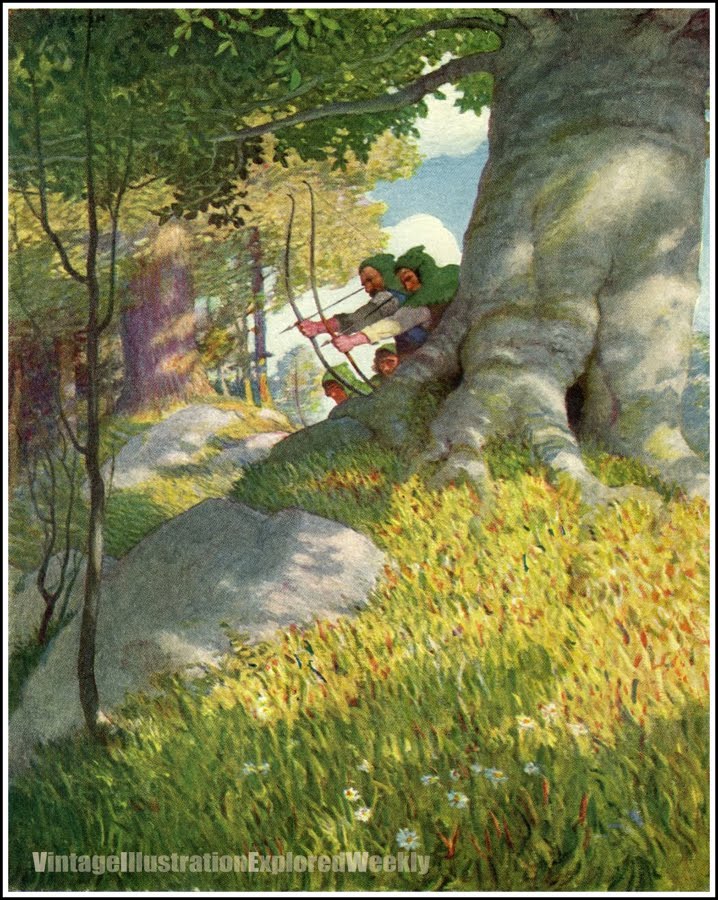
Some of my favorites—Walter Crane (top) near the end of his career, did Robin Hood in 1912. H.J. Ford (second) did his as part of The Book of Romance, in 1902. Howard Pyle's version (third) is full of premier quality line work, and was rewritten by Pyle as well, "to better suit the modern reader". Pyle's version is still reprinted today, and is often the version chosen for text when someone else throws their hat into the "Robin Hood Illustrated" ring.

An unusual arrangement took place between Frank Schoonover (fifth) and Louis Rhead, (fourth) where for a decade or so, books were produced with Rhead's line work, and a color Schoonover cover plate—even though Rhead got occasional color interior work. N. C. Wyeth's oil paintings (sixth) are among some of his best works for Scribner's Classics, and Frank Godwin's brilliant color plates from his 1923 edition (last) almost seem to mark the end of the era. (and these are just the tip of the iceberg...)

Wednesday, January 4, 2012

Uncovering the Working Class Illustrator


Part of my mission here on VIEW has always been to bring to light some of the period illustration that for one reason or another, did not survive the ages. Yes, it's there for us to dig up, but not all of it is as easy to find as Arthur Rackham and Maxfield Parrish. I like finding the "Illustrators that Time Forgot". Most of them did some great work—otherwise they wouldn't have gotten the job in the first place...

Today's subject falls squarely in that category. While he was never a big book illustrator —choosing to work primarily in magazines—that path certainly limited his visible longevity. The few books he did do had little staying power among their titles. Frederick C. Yohn (1875-1933) is a name I've been paging over for years, while I search through old volumes of Scribner's Magazines, Harpers, and Colliers. Yohn was incredibly prolific from about 1895-1920, usually tackling scenes of contemporary living, some light romance, or occasionally the modern war story. (His Spanish-American War works were in high demand at the end of the 1890s) Historic work was also to his liking, and he did many scenes of the Revolution as well. Originally from Indiana, Yohn went on to become of the founders of The Society of Illustrators in NYC.
His skill set, ease with contemporary settings as well as historic ones, and ability, must have made him a reliable work-horse to the publishers that used him.

Pictured here are a WWI poster, three magazine pieces, and a painting that hangs in the Utica Public Library, of General Herkimer at the Battle of Oriskany.

Monday, December 19, 2011

Fine Lines and Solid Blacks, V. III.


If you've followed this blog for some time, you know I'm a big fan of the work of British illustrator H. J. Ford. In conversation with a friend recently , we were discussing that appreciation, when he brought up John D. Batten. (1860-1932). I'd been aware of Batten, but I hadn't really explored his work until this came up.

At times in their careers, the works of Batten and Ford might have been nearly indistinguishable. Primarily line artists, both Batten and Ford often relied on intricate frames to surround their scenes, sometimes with a hand-written caption. Both worked in mythology and fairy stories—and both formed partnerships with writer/historians that explored fairy tales, and made minor heroes out of the illustrators to generations of children. The Batten/Joseph Jacobs partnership thrived throughout the 1890s, when they produced six books— English Fairy Tales, Celtic Fairy Tales, More English Fairy Tales, More Celtic Fairy Tales, Indian Fairy Tales, and The Book of Wonder Voyages. Indian Fairy Tales, in particular, yielded some great pieces of ink work. The last three here are from that book—"The Demon with the Matted Hair" is a fantastic piece of creature design. Tusks and a beak. During my undergrad work, long ago, I did a large ink piece with a complex Celtic frame—which I realize now, was modeled after Batten's style.

--------

My first semester teaching History of Illustration and Animation has wrapped up, and I hope to invest more time in the blog again to help it happen more regularly. Have a great holiday.