Sunday, August 19, 2012

This is a search unfinished.


In long-ago days of my youth, my quest for the sources of great tales lead me to read a lot of Celtic mythology—something I still seek out. I had an old reprinted copy of Celtic Myth and Legend Poetry and Romance, by Charles Squire originally from 1905. My copy then was an English reprint, but Dover publishes it as well, but I'll have to check to see if they printed it with the illustrations or not. I'll get back with that info shortly. There were a few plates among the stories—and the stories themselves—that gave me exactly the kind of thing I was looking for. The art I liked the best within that volume was by an illustrator I had not heard of before, but have kept in the back of my mind, well, for a long time.

Ernest Wallcousins (1883-1976) was a British illustrator, who spent some part of his career working with a studio known as Carlton Illustrators, in London.  Despite scouring my usual sources, and then some, I can find very little info on this artist. Kind of surprising considering he was alive just a generation ago.... But I don't find that a reason to not share some of his work, maybe some of you will find it as inspiring as I have. And if anybody out there has any info on him, PLEASE get back to me about it.

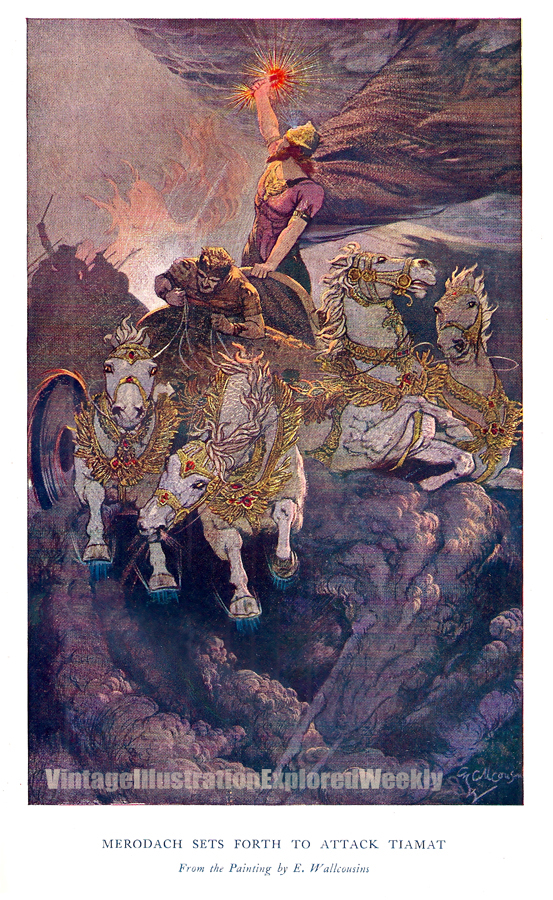
Top to bottom. Three plates from Myths of Babylonia and Assyria, by Donald A. Mackenzie. Same series as the Celtic myth book previously mentioned. The color plates in here are great, all of them from the volume can be seen here.

Two from Pioneers in Canada, by Henry Johnston. I was expecting Henry Hudson and the like... what I got was a lot of outdoor/wildlife images, something else that appeals to me quite a bit. I may post the rest of these as a follow-up in a few months.

A Cover from Bibby's Annual, 1921. Wallcousins seems to have owned this task for quite a few years, producing covers that have a real poster-like quality. Not unlike the image from the myths above—he may have had a thing for chariots.

Two of the "monochrome" plates from Celtic Myth and Legend Poetry and Romance, that put me on his trail in the first place. I've been looking for years, but I've never been able to track down any full color printings of these pieces. They may have been published earlier in color, or, maybe they were only printed this way. (The Dover edition features a Wallcousins image I tinted for our cover.) Maybe you can tell me.
--------------------

We are almost at a century mark for followers. When we hit it, I'll take time to send out a few of my Dover books (YOUR CHOICE!) to 5 interested persons. If you're interested, message me as much. I've signed on as a follower to my own blog(?), so this communication can happen, so make me glad I did....


Wednesday, August 1, 2012

Fine Lines and Solid Blacks, Vol. V


It has come to my attention that sometimes in discussing the more interesting facets of an illustrator, some of the "basics" can be overlooked. Take Harry Clarke (1890-1931) for example. Harry Clarke is one of my favorites of the period. Over the past few years there has been a VIEW post on some really hard-to-find Clarke works, and he was mentioned again in reference to a collected work, more recently. To not offer a look at why I think he's worth some more study, is just, well, wrong. So let's fix that.

In the small amount of time that Clarke had to share his genius with the world, he managed to explore a few creative avenues. Stained glass design may be what he applied most of his time and talent to, and in his native Ireland there still exist many examples of his fine glass work. I found Harry Clarke while in my teens, during an after-Christmas book sale, when a reprint of Poe's Tales of Mystery and Imagination came into my possession. Like many designer/illustrators of the Golden Age, Clarke had the opportunity to do a number of gift books, his were from 1915-1925. The Poe volume is his best known, and easiest to obtain a reprint of. (It was one of the first selected for the Calla reprint program, as well) Clarke's others are not as easy to find, though a reprint of his Fairy Tales of Charles Perrault will be available this Fall. Another of Clarke's prizes is his Fairy Tales by Hans Christian Andersen. All of the works shown here come from that volume. I'm looking at Clarke in a Fine Lines and Solid Blacks segment because I think his ink work is exceptional in his use of pattern and understanding of value—value here meaning the transition(s) between blacks, grays, and whites, and how their relative placement on the picture plane affects the composition. A viewer can observe these images at a glance, or choose to dig deeper and deeper into them, where a single plate can tell its own story. Clarke's color illustration doesn't present with the same intensity through simplicity—black and white—and loses something in the printing, according to some who have seen his originals.


There has been a kind of scholarly-reawakening in regards to Clarke in the last five years, but it does look to his glass work primarily.

You can keep up with that here
and as mentioned in that earlier VIEW blog, here's the link to Jim Vadeboncouer's page on Clarke.


Back shortly. Jeff


Wednesday, July 4, 2012

W. H. Robinson, with even more Kipling


Last October, I put up a post about some beautiful color work by W. Heath Robinson (1872-1944). The imagery up at that time was from The Song of the English, a long poetic piece of writing by Rudyard Kipling. It was one of the first books I acquired while working on my next Dover outing, Golden Age Illustration of W. H. Robinson. Now I bring it around full circle, to the last book I picked up for that same project.

While lacking the amount of pieces that show up in Song of the English, this volume of Kipling Poetry— Collected Verse— has some masterful imagery as well. I almost passed up acquiring it, it has comparatively few color plates— but I stumbled upon a a 1910 Doubleday copy, with all the art, and a nearly detached cover...that I got very reasonably. So let me share a few of these with you, as a preview of the upcoming book. As for the illustrative years of W. H. Robinson's career, (who later went on to become a very successful cartoonist, leaving more traditional book illustration to others) the works he did for these two Kipling volumes in 1909 and 1910 are among his best. Other books that will be featured in the upcoming Dover work include images from The Water Babies, A Midsummer Night's Dream, and some of W. H. Robinson's own writings— Uncle Lubin and Bill the Minder.

Next month at some point, I'll bring out some of the best work from his older brother, Charles.

---------

Return from the Edge

I've been to the Edge—and it was terrific. If you have ANY CHANCE AT ALL to get to the show mentioned in my last post, don't let it get past you. Three big gallery rooms, packed with a wealth of the best fantastic creatives out there. Thank you, Pat and Jeannie, and thank you Allentown Art Museum.


Wednesday, June 13, 2012

Summertime is Time to Travel. The Wonders We Will See!


Being up to my neck in large scale projects this week—and for quite a few more to come— it's been easy to let days slide away, but I'm determined to attempt to maintain some regular connections.

Before any more time goes by, I have to alert VIEW's readers to two amazing shows currently on display in the Northeast corner of the US. The first is from some folks I'm proud to call friends, Pat and Jeannie Wilshire of Illuxcon fame have guest curated an exhibit now on display at the Allentown Art Museum in PA.

At the Edge is a show unlike any other I've ever known to have been assembled. It contains the best in "fantastic" art, (in the sense of "fantastical") from nearly 150 years ago up to the best Imaginative Realist painters going today. The list is mind-blowing. While the current crop of top illustrators makes an annual appearance at Illuxcon and is well represented in this show, it is the historical (i.e. "vintage")  stuff that this blog focuses on— and WOW, they've pulled some masterworks out from private collections (The Kelly Collection, and The Korshak Collection, and others). This is an extraordinary opportunity to see some outstanding pieces, from many of the artists that we discuss here with some regularity. Shown at the right, Dean Cornwell, Wladyslaw Benda, Edmund Dulac, J. C. Leyendecker and Franklin Booth... All in one place. Thanks to the Wilshires for permission to repost those images here on VIEW.

The Allentown show runs until September 9th, and appears to be continually hosting lectures by the biggest and the best. The Wilshires themselves will be there this Sunday, to present  a lecture on the imagery of the fantastic—Imagining Reality with Pat and Jeannie Wilshire (Roger Dean will be there a week from now...)  They are doing so much to help fantastic imagery get the respect it deserves. Worth a vacation day, for sure.

AND IF THAT'S NOT ENOUGH

The Howard Pyle Centennial exhibit is showing again, now located at the Norman Rockwell Museum in Stockbridge Mass.

If you weren't able to make it when it was at the Delaware Art Museum, It will be in Mass. until October 28th. I posted some comments on the show when I first saw it, but I am planning on seeing it at the Rockwell also.

Time to hit the road.