Showing posts with label Celtic Mythology. Show all posts

Sunday, August 19, 2012

This is a search unfinished.


In long-ago days of my youth, my quest for the sources of great tales lead me to read a lot of Celtic mythology—something I still seek out. I had an old reprinted copy of Celtic Myth and Legend Poetry and Romance, by Charles Squire originally from 1905. My copy then was an English reprint, but Dover publishes it as well, but I'll have to check to see if they printed it with the illustrations or not. I'll get back with that info shortly. There were a few plates among the stories—and the stories themselves—that gave me exactly the kind of thing I was looking for. The art I liked the best within that volume was by an illustrator I had not heard of before, but have kept in the back of my mind, well, for a long time.

Ernest Wallcousins (1883-1976) was a British illustrator, who spent some part of his career working with a studio known as Carlton Illustrators, in London.  Despite scouring my usual sources, and then some, I can find very little info on this artist. Kind of surprising considering he was alive just a generation ago.... But I don't find that a reason to not share some of his work, maybe some of you will find it as inspiring as I have. And if anybody out there has any info on him, PLEASE get back to me about it.

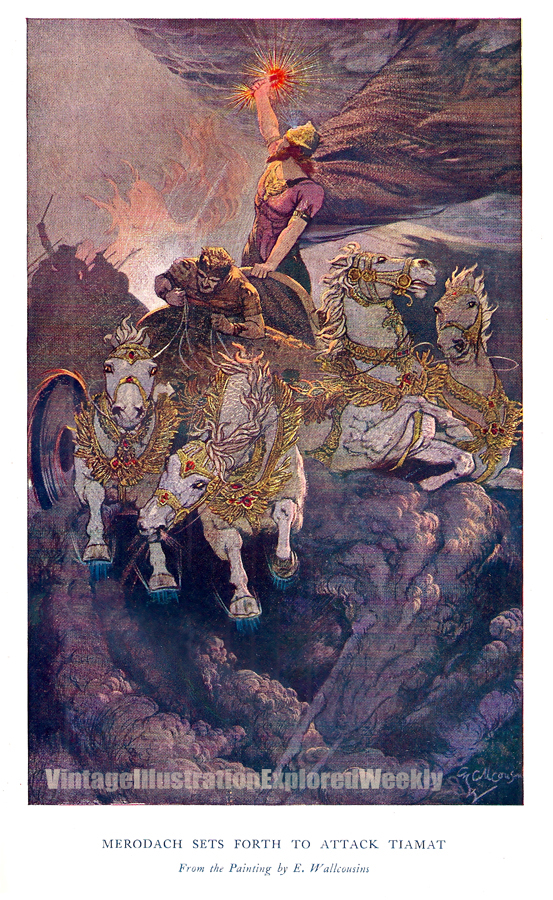
Top to bottom. Three plates from Myths of Babylonia and Assyria, by Donald A. Mackenzie. Same series as the Celtic myth book previously mentioned. The color plates in here are great, all of them from the volume can be seen here.

Two from Pioneers in Canada, by Henry Johnston. I was expecting Henry Hudson and the like... what I got was a lot of outdoor/wildlife images, something else that appeals to me quite a bit. I may post the rest of these as a follow-up in a few months.

A Cover from Bibby's Annual, 1921. Wallcousins seems to have owned this task for quite a few years, producing covers that have a real poster-like quality. Not unlike the image from the myths above—he may have had a thing for chariots.

Two of the "monochrome" plates from Celtic Myth and Legend Poetry and Romance, that put me on his trail in the first place. I've been looking for years, but I've never been able to track down any full color printings of these pieces. They may have been published earlier in color, or, maybe they were only printed this way. (The Dover edition features a Wallcousins image I tinted for our cover.) Maybe you can tell me.
--------------------

We are almost at a century mark for followers. When we hit it, I'll take time to send out a few of my Dover books (YOUR CHOICE!) to 5 interested persons. If you're interested, message me as much. I've signed on as a follower to my own blog(?), so this communication can happen, so make me glad I did....


Thursday, March 17, 2011

St. Patricks predecessors


This is just a quick stop-by. I'm loading the car/truck/vehicle to get to Lunacon In Rye, N.Y. tomorrow. But it has been on my mind all week that back in December I commented that I'd put up some more Celtic myth work from Stephen Reid, for St. Patricks day. So let me stick to that. Here's to the old gods.
------
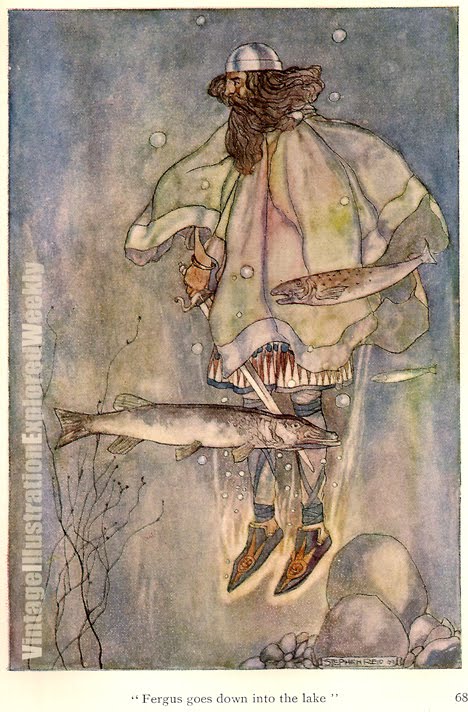
As promised, I have more Celtic mythology from Scottish illustrator Stephen Reid. (1873-1948)
When I last mentioned his work, back on December 18th, I had just gotten my hands on one of two volumes of Celtic themed work that Reid did over a century ago. In what I can find of his other works, very few of them achieve the fluid forms that these pieces seem to capture, and his palette is diverse enough, yet still totally natural. This group of images is from the more recent acquisition—and a really tough one to get a hold of—Cuchulain, The Hound of Ulster, by Eleanor Hull, 1910. (Which seems to have also gone by the title The Boys' Cuchulain)

It seems that there were many reprints, and it is certainly easy enough to find a print-on-demand copy these days, but finding an early edition with all 16 plates in color, that's a challenge. As luck would have it, even this copy, showed up missing a plate. So close.

Jeff

Saturday, December 18, 2010

Ring out Solstice Bells


The Solstice arrives this coming Tuesday. Marking the longest night of the year, it has special meaning to many people. This year's is especially spectacular, as it is not only coupled with a full moon, but also a FULL LUNAR ECLIPSE, visible all over the US. Holy Druids.

These old-world calender events always make me think of the myths and legends that make use of such happenings. Having just acquired a long sought-after book featuring some great pieces from Celtic myth, this seems like an appropriate enough occasion to share them.

Stephen Reid (1873-1948) is not a name you will come across in any (but the most thorough) of the books on Golden Age illustrators. His work was very good when he was at top form—but it was not always consistent. In his later work he went to an opaque medium, and lost a good deal of the sensitivity he captured here. Reid managed to hit a lot of the subjects I am passionate about—pirates, medieval history, and Celtic myth. These first four plates are a selection from The High Deeds of Finn and Other Bardic Romances of Ancient Ireland, by T. W. Rolleston, Harrap. 1910. This is what I just got a hold of, happy centennial, Finn. Featuring Reid's earlier watercolor work, his palette choice and usage of transitioning color manages to lend a nice dream-like feeling to these pieces, which benefit the faerie/other-worldly aspects of the setting. The last image is from an even earlier work, by Eleanor Hull—which is one of the pieces that inspired me to hunt down these color plates. I have a copy of that volume with the color on the way...I'll post those for St. Patrick's day. . .

-----

Speaking of "working Joe" illustrators—
One of the things I love to do here is find the folks who gave a real go of it, but never achieved the stardom of those few—and might have gotten lost a bit in the past 100 years or so. Reid definitely fits that category. He seemed to stick around for a while, I guess he was a nice guy who handed in his work on time, but maybe didn't do AWESOME work all of the time.
This past week I found another blog entry who looked at this situation with real insight. Let me share that with you, and thanks to David Apatoff at Illustrationart for putting these thoughts down.

-----


Be careful with your golden sickle cutting the mistletoe.

Monday, June 15, 2009

The Man and the Myth


Most of what fills this blog are comments on book illustration. It is the form of illustration that I'm the closest to— both by virtue of the books that I compile, and the illustration I do myself. There are tons of great illustrators out there, that did very little (if anything) for the book market—for many reasons. Book work does not pay the best. In books, you have to produce a large body of work—it is a bigger commitment. Magazines are faster, usually pay a bit more, and it's normally 1-3 pieces. Advertising is king in regards to a paycheck. Do a job for a corporate client or ad agency, those jobs can really pay some bills.

One of the best known advertising illustrators of the early 20th century was J. C. Leyendecker (1874-1951). J. C., or Joe, was the older of two brothers—Frank was also a fairly successful illustrator. The brothers Leyendecker were born in Germany, raised and apprenticed in Chicago, studied in Paris, and became a huge stars in New York. (Again, that magic date...where was he in 1900? Moving from Chicago to NY, 26 years old, a year after painting his first Saturday Evening Post cover...)

J. C.'s major contributions—Preceding Norman Rockwell, he was the leading illustrator of the Saturday Evening Post (321 Covers!) and his ability to produce a smart, strong, male image led more than one clothier to his studio door. The product that his art would carry and sell for decades was the Arrow Shirt collar. (Top image, Arrow Collar ad, 1912) Advertising clients like Arrow made Leyendecker a wealthy man, and he went through money as fast as it came in.

Both brothers painted in a similar style, having some tell-tale features that separate a Leyendecker work from others. STRONG brush strokes. Lines often look chiseled; sculpted, almost. Beautiful directional qualities. Contour of the primary figure is the most important design element. Keeps the statement strong and simple, and that attention to profile makes the image communicate efficiently.

While doing research for a project, I came across a box of clipped illustrations, mostly from Century Magazine. In the bottom of this pile, I found three Leyendecker pages—far less commercial than what I had known him for. Two were from an article (Written by Teddy Roosevelt, no less) on the Ancient Irish Sagas (January, 1907 issue). The pieces depict Cuchulain in Battle, and Queen Meave, both leading figures in Celtic mythology. The Cuchulain piece has always captivated me- great details, while getting in real close, showing the chariot, with only a hint of the horse. The other image is Old Testament— also from Century, it is for a poem called The Death of Eve, by William Vaughn Moody. This depiction of Eve—and son Cain—is unlike any I have ever seen, with the low mist making the figures feel like giants. A big step from an Arrow shirt. I have to wonder if J. C. enjoyed such imaginative diversions from his bigger, commercial clientele. I certainly appreciate them.

Jim Vadeboncoeur's bio of JCL at Bud Plant
American Art's great Leyendecker page

Back soon


Jeff