Showing posts with label Wyeth. Show all posts

Tuesday, January 17, 2012

Welcome to Sherwood


In an age before what is now known as "gaming".... before The Lord of the Rings had hit the big screen in any form, there were a different set of mythic heroes. They are still around, but they don't command the stage they way they did in a time before role-playing, blu-ray, and the "six-book series"...

Books that were read over and over, stories told for generations, were some of the tales that got the royal treatment when it came to illustrated editions that appeared near the turn of the last century. One such story that has always grabbed my attention is that of Robin Hood. I've always enjoyed that period in history, and that particular story. Many 1900 era publishers saw the appeal to the tale as well, and many saw fit to add it to their list at one point or another.
Of my illustration collections that Dover Publications has published, most are thematic by artist, but some are compiled by subject. The first of these was Illustrations of Poe, and the Arabian Nights illustrations were particularly well received. There are a half a dozen or so such titles now, but Robin Hood didn't grab the publisher's interest. I've collected quite a few editions, and thought it could be of some value to share them here on VIEW. Comparing how different artists look at the same story helps you find distinctions, that may help your own illustration or just enjoy one group more than another.

Some of my favorites—Walter Crane (top) near the end of his career, did Robin Hood in 1912. H.J. Ford (second) did his as part of The Book of Romance, in 1902. Howard Pyle's version (third) is full of premier quality line work, and was rewritten by Pyle as well, "to better suit the modern reader". Pyle's version is still reprinted today, and is often the version chosen for text when someone else throws their hat into the "Robin Hood Illustrated" ring.

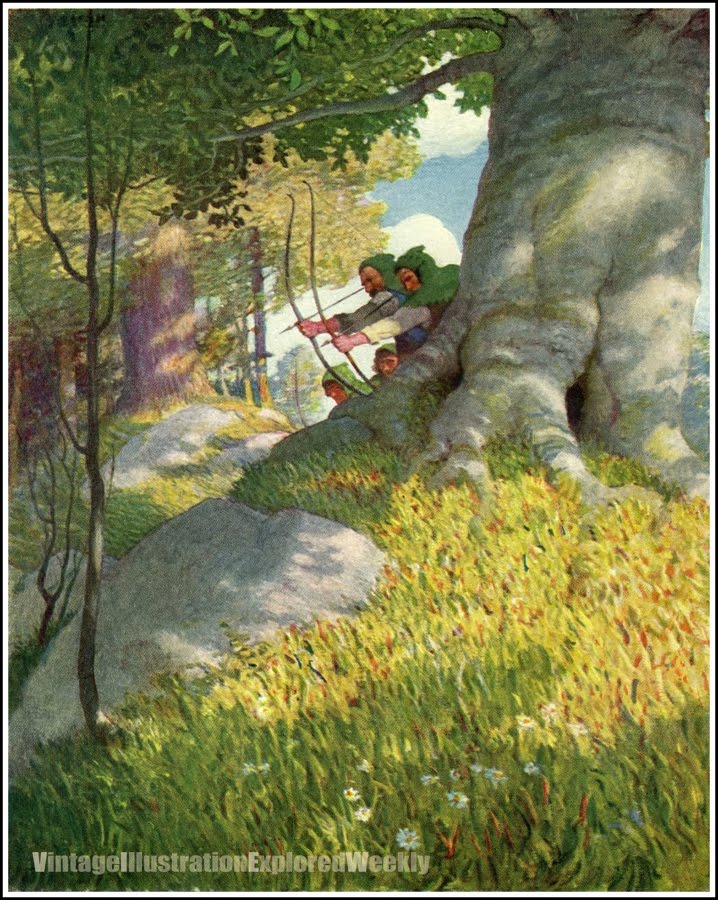
An unusual arrangement took place between Frank Schoonover (fifth) and Louis Rhead, (fourth) where for a decade or so, books were produced with Rhead's line work, and a color Schoonover cover plate—even though Rhead got occasional color interior work. N. C. Wyeth's oil paintings (sixth) are among some of his best works for Scribner's Classics, and Frank Godwin's brilliant color plates from his 1923 edition (last) almost seem to mark the end of the era. (and these are just the tip of the iceberg...)

Tuesday, January 4, 2011

The Virtues of Gray?


This post is a question that has recently been tossed about in my editorial head.

A great deal of work in the Golden Age of illustration was published as halftone (or grayscale) art. For every nice color plate I find for a new Dover publication, or to post here on VIEW, I find three that were printed in various tones of gray.

My question is— Does that work hold any value and or interest to this audience today? I'm not speaking about the general public, I mean people who are fans of illustration for whatever reason, and who are usually the ones who throw down a few bucks for a Dover collection of Golden Age images? If you've been tempted to comment in the past but haven't, or even if you have, THIS IS YOUR WEEK. Throw me some comments, let me know, it could—no, will—affect the selection and layout of my next book to be submitted....

SO—To help the discussion, or at least what I hope will be one, I've picked a few pieces of grayscale art that I have found worth looking at more than once. I don't want to influence your comments on this, so I'll just give you the facts, and you tell me, does this material merit some study, would you pass it up, or is it as worthwhile as a similar color plate?

This first piece picks up on the last entry- The Prospector is an N. C. Wyeth piece from a McClure's Magazine, 1906.
Wyeth's teacher follows, that's Howard Pyle with Blackbeard's last fight, Century Magazine, 1894.
Sydney M. Chase is weighing the fish from Scribner's, June, 1908.
Fourth is Woldemar Fredirich, with a scene of "The Wild Huntsman" from The Illustrator, 1895.
and last is George Wright, with the firefighting scene, Scribner's, 1902.

Let me know if this kind of imagery is welcome in a book you might buy today, and why. Comments encouraged.

Monday, December 27, 2010

Snowday, Wyeth style


I start this post in the immediate aftermath of a Northeast blizzard, one strong enough to shut down the railroad, and grant me a snow-day to follow the Christmas break.

It occurred to me that a new bunch of N. C. Wyeth (1882-1945) prints that have trickled into the studio share this wintry vision. Living where I do, it's not uncommon to see some snow on the ground from December to March, and it always surprised me that it doesn't show up in more work, from anyone who lives in the north. N. C. must've liked the snow as well, because looking over a group of his early works, a large percentage of them are snow scenes, including one of my most favorite Wyeth pieces. Seemed like a good theme to explore on a snow-day. Without taking it for granted—Newell Convers Wyeth is one of the most important illustrators of the twentieth century. He joined Howard Pyle, studying under him at the Brandywine, and Wyeth soon became Pyle's star pupil. Wyeth had an incredibly prolific career in both book and magazine work. He was also the patriarch of what became America's first family of art, with his son Andrew Wyeth, and grandson Jamie Wyeth being the central figures of three generations of Wyeth artists.

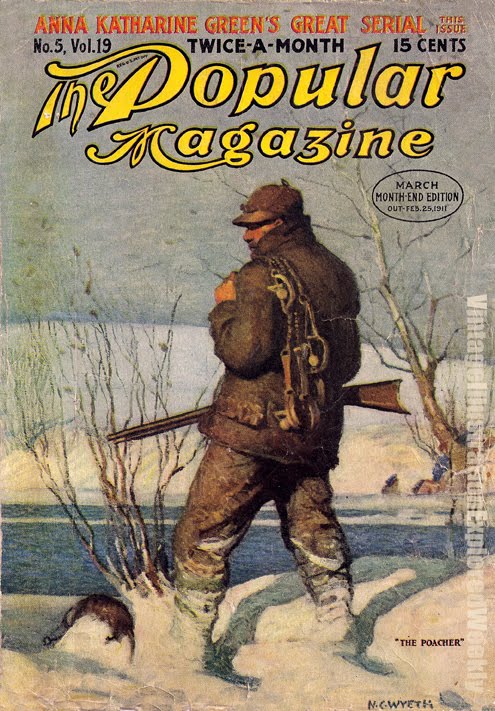
The images— a few nice covers from The Popular Magazine, including this cover with a Yukon adventure look to it- Polar bear, Native Americans, a trusty Colt .45. A second features one of N.C.'s strong solitary thinkers, in this case, a poacher...
A few plates from The Outing Magazine, January 1907- from a story entitled "How they Opened the Snow Road"
and a pair of plates from two classics—
The frontispiece from Mark Twain's last novel, The Mysterious Stranger (a read which I enjoyed tremendously in my college days)
and a piece I have the highest amount of respect for, from Robert Louis Stevenson's The Black Arrow, (also a good read)

Wyeth used snow in many of these pieces the way he used dust in his even earlier (or contemporary) western themed works—providing a light field, it helps him to increase contrast and strengthen shadows. He also frequently simplified figurative areas into definitive shapes, and obscured the details of distant backgrounds that would otherwise distract from the focus of the piece.

Stay warm. See you in the New Year, here's to a good one!

Sunday, September 19, 2010

Raise a glass, you scurvy dog.


You probably didn't know that today (OK, yesterday...)is International Talk Like a Pirate Day. It is, look it up, I'll wait.
OK, I'll use this occasion to do two things. First, to herald the start of Pirate Season, which runs (in my house) from Talk-Like-a-Pirate day until Halloween. Second, let's take a look at the pirate in Golden Age illustration. (Cue groans from FIT MA alums). Though I've managed to shy away from the topic in almost all my previous VIEW blog posts, it is well-known here in the NY area, that I have a strong interest in the imagery of the Pirate, and that in fact, it was the topic of my Master's Thesis.
OK, so it's ITLAPD, no reason to hold back—
Five of my favorite Golden Age Pirate illustrators, and why-

5. Frank Schoonover (1877-1972), If N. C. Wyeth was Pyle's "best" student, Schoonover was a close second, and probably closer to Pyle. Schoonover kicked out some very respectable, gutsy pirate pieces, including a great story on Jean Lefitte, a figure rarely visited in the genre. This (top image) is my favorite image of Blackbeard.
4. Dean Cornwell 1892-1960. Had a real interesting feel for the subject, with an uncanny sense of outdoor light on deck. Cornwell was a student of Harvey Dunn, Brandywine alum, making him a second generation Pyle student.
3. N. C. Wyeth 1882-1945. Pyle's prize student, he created masterworks for Treasure Island and Kidnapped. Though he did do a handful of other pirate pieces in his career, I don't see the subject as one that interested him more than any others; he was good at them all.
2. Norman Price 1877-1951. After Pyle's passing, and with Wyeth in incredible demand, the job of top pirate illustrator might have been split between Schoonover and Norman Price. Though almost any Brandywine student was capable of pulling off a good pirate piece, Price (who was not a Brandywine alum) came repeatedly to the subject, including many illustrated editions of Robert Chambers' pirate tales throughout the 20's, and did a nice Treasure Island as well.
1. Howard Pyle 1856-1911. Set the bar. It wasn't only his style of work, but it was the research that Pyle did into the subject. in 1889 Pyle traveled to Jamaica, which helped him create a colorful, but believable image, that shaped the way the world has thought of Caribbean pirates ever since.